Is WhatsApp Allowed for Patient Messages? India, UK, Singapore, UAE, US
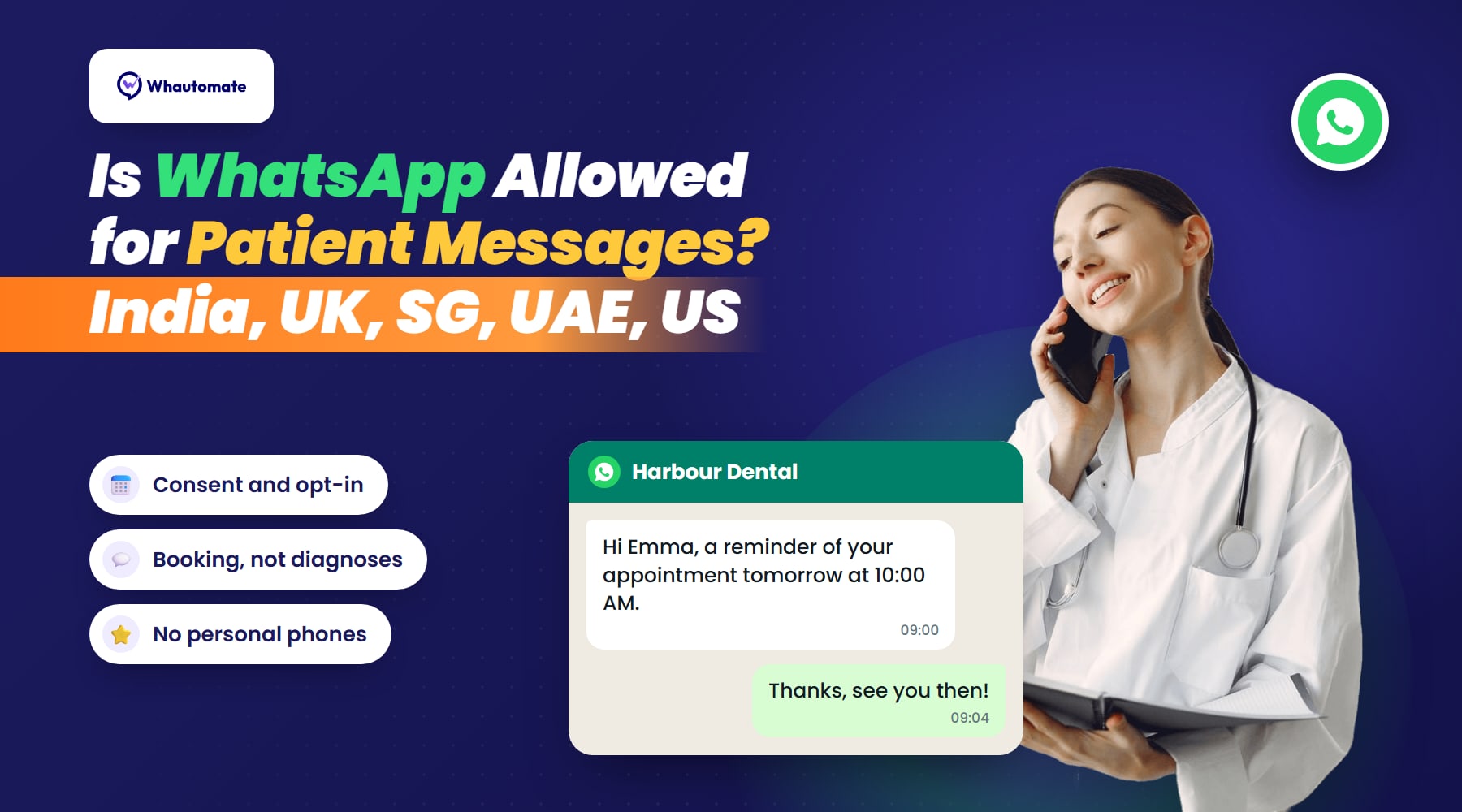
Patients already message practices on WhatsApp. They ask about prices, book appointments and say they are running late. But many practice owners are unsure whether they are actually allowed to reply, send reminders or share anything about a patient’s care on WhatsApp.
The honest answer is: it depends on what you send and where you are. In most of the countries below, using WhatsApp for booking, reminders and practical questions is common and workable, with consent and care. Sending clinical details is a different matter, and in some countries it is clearly not appropriate on WhatsApp.
This article is general information, not legal advice. Rules change, and they differ by profession. Check with your regulator, professional body or a lawyer before you rely on any of it. Last reviewed: November 2026.
The one distinction that matters most
Almost every rule below treats two kinds of message very differently:
- Practical messages: booking confirmations, reminders, rescheduling, opening hours, directions, payment links. These contain little or no health information.
- Clinical messages: diagnoses, test results, treatment details, prescriptions, consultations.
If you keep WhatsApp for practical messages, and handle clinical content through the systems and processes your profession expects, you avoid most of the risk.
WhatsApp’s own rules apply everywhere
Before any national law, WhatsApp has its own Business Messaging Policy. Two points matter for practices:
- Opt-in: you may only message people who gave you their number and agreed to receive messages from you.
- Health information: the policy says not to use WhatsApp for telemedicine or to send or request health information where local regulations require systems that meet heightened requirements.
In other words, WhatsApp itself expects you to follow your local health privacy rules, and to keep health information off WhatsApp where those rules demand more.
India
- Doctors: the 2020 Telemedicine Practice Guidelines for registered medical practitioners list messaging platforms such as WhatsApp among the tools that can be used for teleconsultation. Doctors are expected to show their registration number in electronic communications and to keep a record of the interaction. These guidelines apply to registered medical practitioners, not to physiotherapists, dentists, vets or counsellors, who should follow their own councils.
- Data protection: the Digital Personal Data Protection Act, 2023 and its 2025 Rules set duties for anyone handling personal data, including patient details. The main obligations (clear notice of what you collect and why, consent that can be withdrawn easily, security and breach reporting) come into force in stages, with most applying from 2027. Health data is not a separate category under the Act, but it is still personal data, so collect only what you need and explain how you use it.
In practice: booking and reminders on WhatsApp are widely used in India. Get consent, keep messages practical, keep records, and prepare for the DPDP notice and consent duties.
United Kingdom
- Health data is “special category” data under UK GDPR. You need a lawful basis and an additional condition to use it. Providing health or social care is one of those conditions.
- The ICO has acted on careless WhatsApp use. In 2023 it reprimanded NHS Lanarkshire after staff shared patient details in a WhatsApp group more than 500 times, and a non-staff member was added by mistake. The problem was staff using an informal group chat with no policy, not a business messaging patients properly.
- NHS guidance on messaging says no app is endorsed, patient-identifiable information should be kept to a minimum, and messages do not replace the clinical record.
- Reminders vs marketing: under PECR, appointment reminders are service messages, not marketing. Add a promotional offer to the same message and it becomes marketing, with stricter consent rules.
In practice: keep reminders free of clinical detail, use a business account rather than staff group chats, keep anything clinical in your record system, and do not mix offers into reminders.
Singapore
- The PDPA requires consent and notice for collecting and using personal data, and limits use to the purposes you told people about.
- The PDPC’s Advisory Guidelines for the Healthcare Sector (revised 2023) give a helpful example: a dental clinic text sent solely to remind a patient of their appointment is unlikely to be a marketing (“specified”) message, so Do Not Call rules would not apply. Messages that promote services are different: they need a DNC check or clear consent.
In practice: appointment reminders are generally fine with the patient’s consent. Treat promotions and health tips for non-patients as marketing.
United Arab Emirates
- Federal Law No. 2 of 2019 on the use of ICT in health fields restricts storing, processing or transferring health data outside the UAE, with exceptions set by ministerial decision.
- Dubai Health Authority telehealth standards require telehealth platforms approved by the TDRA, with data stored in a UAE-based certified cloud.
In practice: use WhatsApp for practical booking messages only, with no health information. Consultations and clinical data belong on platforms approved by your health authority. If you are in the UAE, check with your authority (DHA, DoH or MOHAP) before using any messaging app for anything beyond logistics.
United States
- Under HIPAA, providers can communicate with patients by email or text in many situations, and HHS guidance says providers should generally accommodate a patient’s reasonable request to receive reminders that way, with reasonable safeguards.
- However, Meta does not publicly offer a HIPAA business associate agreement for WhatsApp. Most US practices therefore treat WhatsApp as unsuitable for protected health information, and keep any WhatsApp messages to minimal, non-clinical content, if they use it at all.
- Texting rules under the TCPA also apply to certain messages, with a specific exemption for some healthcare messages such as appointment reminders. How these rules apply to WhatsApp is not settled.
In practice: in the US, use HIPAA-appropriate systems for anything clinical. If patients ask to be reached on WhatsApp, keep messages to scheduling basics.
A practical checklist for any country
- Get consent to message patients on WhatsApp, and record it. Make it easy to opt out.
- Keep messages practical. Times, dates, directions, payment links. No diagnoses, results or treatment details.
- Use a business account, not personal phones. Staff messaging patients from their own WhatsApp is how most problems start.
- Limit who can see what. Give staff access to the conversations they need, and remove access when people leave.
- Keep clinical decisions in the clinical record, not in a chat thread.
- Separate reminders from marketing. Different consent rules apply.
- Know where data is stored if your country restricts health data leaving it.
- Check your profession’s rules, not just general data protection law.
How Whautomate fits
Whautomate is built for the practical side of patient communication: enquiries, booking, reminders and follow-ups. It runs on the official WhatsApp Business Platform with your business number in a shared team inbox, so staff do not need to use personal phones, and conversations stay with the practice when people leave. You write your own reminder templates, so you control exactly what they contain, and broadcasts handle opt-outs. Whautomate does not make any practice “compliant” on its own. That depends on how you use it and on your local rules, so use the checklist above alongside your regulator’s guidance.
Frequently asked questions
Can I send appointment reminders on WhatsApp?
In most of the countries covered here, yes, with the patient’s consent and with messages kept practical (date, time, place, reschedule link). Avoid clinical details in reminders.
Can I send test results or diagnoses on WhatsApp?
Generally, no. Treat clinical information as needing the systems your profession and regulator require. WhatsApp’s own policy says not to send health information where local rules require heightened protections.
Is WhatsApp HIPAA compliant?
Meta does not publicly offer a HIPAA business associate agreement for WhatsApp, so US practices generally should not use it for protected health information.
Is it a problem if staff message patients from their personal WhatsApp?
It is one of the most common causes of privacy problems: no oversight, no record, and patient details left on personal phones. A shared business inbox avoids this.
Do the rules differ for physios, dentists, vets and counsellors?
Yes. India’s telemedicine guidelines, for example, apply to registered medical practitioners. Other professions follow their own councils and codes, and vets’ client data rules differ from human patient data. Check your own professional body’s guidance.