WhatsApp Marketing for Clinics and Practices: What to Send, What Not To
Most clinics think of WhatsApp marketing as offers and broadcasts. For a physio, dental, vet, aesthetic or counselling practice, the messages that actually bring revenue are quieter: the reminder that prevents a no-show, the recall that brings a patient back for their check-up, the follow-up that turns one visit into a course of treatment.
This playbook covers what a practice should send on WhatsApp, how to get consent, what it costs, and what you should never send. It includes 12 campaigns with message copy. It is about getting patients booked and back, not about clinical care: keep diagnoses, results and records in your practice system.
This is general information, not legal advice. Healthcare advertising and privacy rules differ by country and profession. Check with your regulator or a lawyer before you rely on it. Last reviewed: November 2026.
What “marketing” means for a clinic
For most practices, WhatsApp marketing is retention, not promotion:
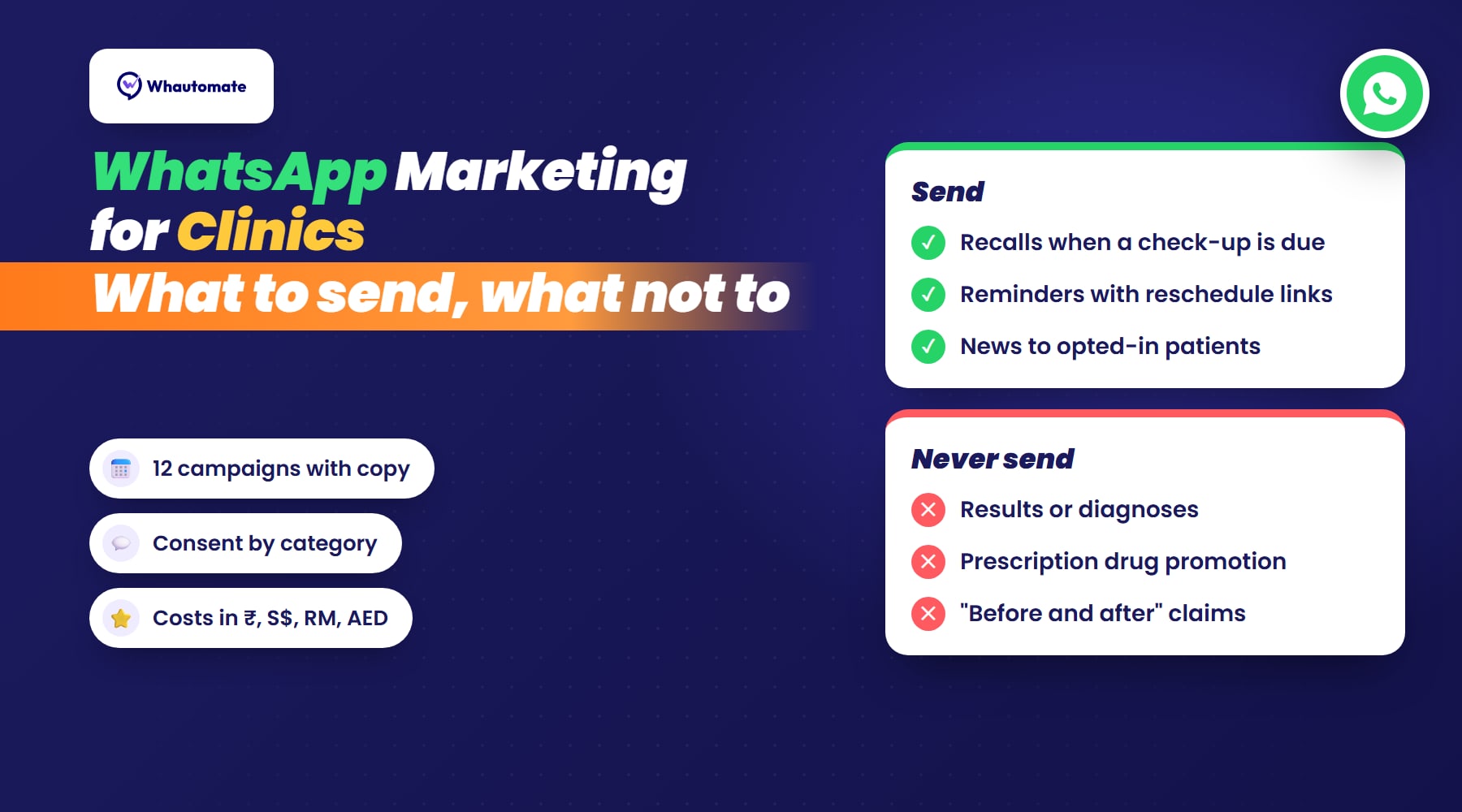
- Recalls: the six-month dental check-up, the annual vaccination, the physio review.
- Reactivation: patients who started a course of treatment and stopped coming.
- Follow-ups: a check-in after a visit, a review request, a reminder to book the next session.
- Occasional launches: a new service, a class, a seasonal package.
The first three are messages patients expect and usually welcome. The fourth is where consent, local advertising rules and frequency matter most.
Consent: ask by category
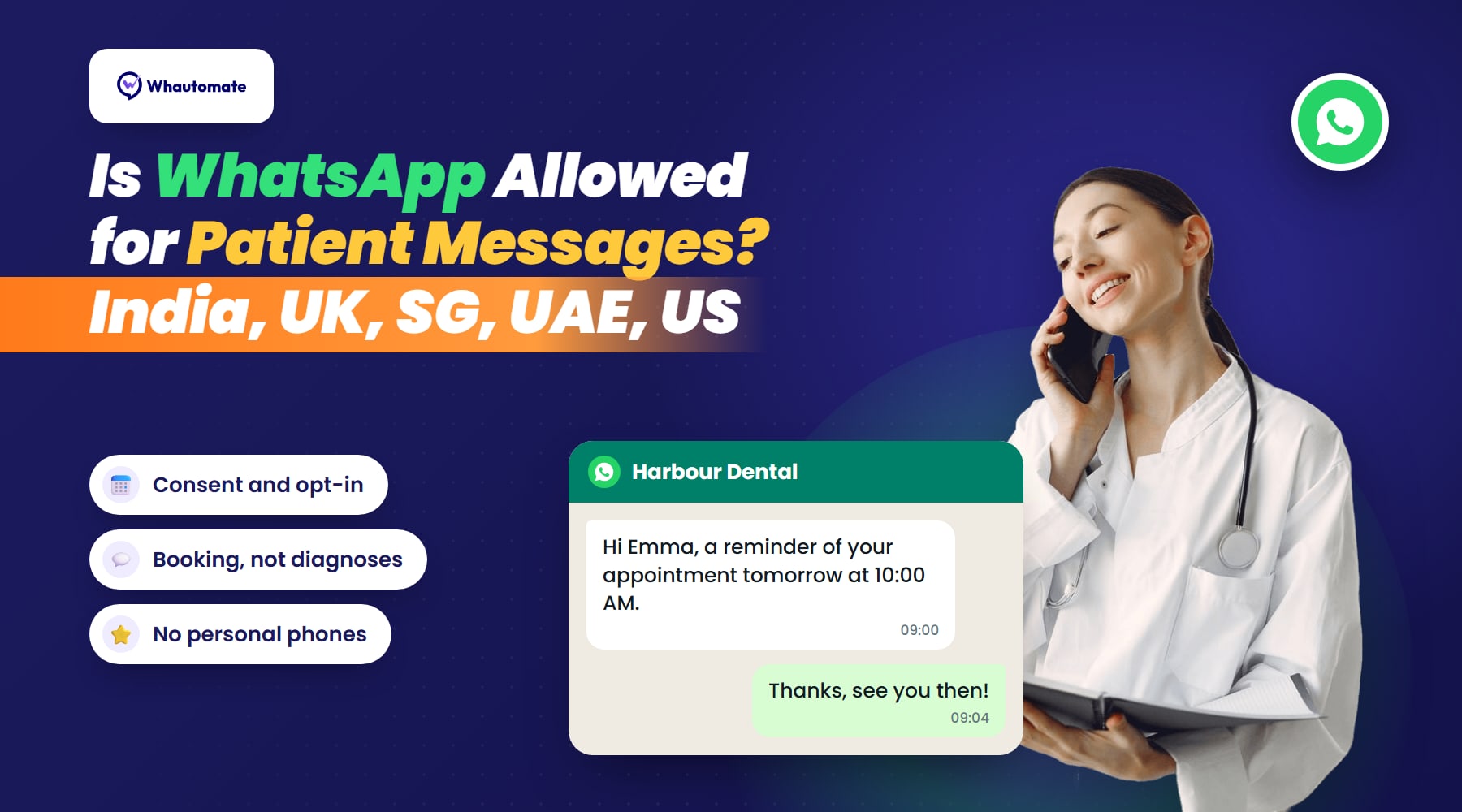
WhatsApp’s Business Messaging Policy says you may only contact people who gave you their number and agreed to receive messages from you. It recommends asking for opt-in by message category and giving a clear way to opt out of each.
For a practice, that means two separate tick boxes on your registration or booking form:
- “Send me appointment confirmations and reminders on WhatsApp.”
- “Send me news and offers from [Clinic name] on WhatsApp.”
A patient who unticks the second still gets their reminders. Collect consent where it naturally happens:
- Online booking and registration forms: a tick box per category.
- At reception: a QR code on the counter that opens a WhatsApp chat, with the opt-in wording in the first message.
- Click-to-WhatsApp ads: the patient starts the chat, so your reply is not unsolicited, but ask before adding them to promotions.
Keep a record of when and how each patient opted in, and honour “STOP” straight away.
Utility or marketing: what each message costs
Meta classes every template as utility, marketing or authentication, and prices each delivered message by category and the patient’s country.
- Utility: a confirmation, reminder or recall about a specific appointment, with no promotion.
- Marketing: anything promotional, including “book your next check-up and get 10% off”. A template that mixes the two is treated as marketing.
Meta’s list rates from 1 October 2026, per delivered template:
| Patient’s country | Utility (reminder, recall) | Marketing (offer, launch) |
|---|---|---|
| India | ₹0.115 | ₹0.8631 |
| Singapore | S$0.0205 | S$0.0937 |
| Malaysia | RM0.0564 | RM0.3467 |
| UAE | AED 0.0576 | AED 0.2115 |
| Saudi Arabia | SAR 0.0401 | SAR 0.2159 |
Keeping recalls and reminders free of promotion keeps them in the utility category: cheaper, and less likely to annoy. Replies you send while a patient is chatting with you are service messages; the first 1,000 a month per number are free. See our WhatsApp API pricing page for other countries.
What not to send
WhatsApp’s policy contains one line every practice should read:
“Don’t use WhatsApp for telemedicine or to send or request any health related information, if applicable regulations prohibit distribution of such information to systems that do not meet heightened requirements to handle health related information.”
The same policy restricts promotion of medical and healthcare products and drugs. In practice:
- No diagnoses, results or treatment details in WhatsApp messages. Say “your results are ready, please call us or log in” instead.
- No health questionnaires over chat where your rules require secure systems. Send a link to your form system instead, if it is appropriate for your country.
- No prescription drug promotion, and no promotion of medical devices or test kits.
- No testimonials or “before and after” claims where your country bans them in clinic advertising.
- No superlatives such as “best”, “guaranteed” or “100% safe”.
- No full ID or card numbers. The policy also bans sending full payment card numbers and national ID numbers.
The same rules apply to automatic replies: a bot should never answer clinical questions. It should help the patient book, and point to emergency services when something is urgent.
Country rules at a glance
| Country | What to know | Source |
|---|---|---|
| India | The NMC put its 2023 Professional Conduct Regulations on hold, so the 2002 Code of Medical Ethics Regulations still govern how doctors advertise and bar soliciting patients; reports of further NMC advertising guidelines in October 2026 describe a ban on patient testimonials, so check the latest NMC text. The DPDP Act and 2025 Rules require clear consent, phasing in through 2027. | NMC Code of Medical Ethics, DPDP Rules summary |
| Singapore | The HCSA advertisement regulations ban paid testimonials and claims that create unrealistic expectations. Marketing messages to Singapore numbers fall under the PDPA’s Do Not Call rules unless you hold clear consent. | MOH HCSA advertising rules, PDPC DNC guidelines |
| Malaysia | Advertisements by private clinics and hospitals need prior approval from the Medicine Advertisements Board, so a promotional broadcast may count as an advert. | Medicine Advertisements Board |
| UAE | Health advertising on social media needs a permit, and the DHA’s standards ban words such as “best”, “guaranteed” and “no side effects”; reports say the rules include WhatsApp, so check the current DHA and MOHAP requirements. | DHA social media standards, MOHAP licence |
Where the rules are unclear, keep promotional messages factual and send them only to patients who opted in to offers.
12 WhatsApp campaigns for clinics and practices
Words in {{double braces}} are Whautomate personalisation variables, filled in for each person (see the full list of variables); text in [square brackets] is yours to write. Messages sent more than 24 hours after the patient last wrote to you must be approved templates.
Recalls and reminders (utility)
1. Six-month dental check-up recall
Hi {{client.firstName|there}}, your {{recall.serviceName}} at {{business.name}} is due on {{recall.dueDate}}. Book a time that suits you: {{recall.bookURL}}
2. Vet vaccination due
Hi {{client.firstName|there}}, [pet name] is due for their {{recall.serviceName}} on {{recall.dueDate}}. Book here: {{recall.bookURL}}
3. Physio review after a course of treatment
Hi {{client.firstName|there}}, it has been six weeks since your last session with {{appointment.practitioner}}. A short review appointment helps make sure your progress holds. Book here: [your booking link]
4. Appointment reminder with one-tap confirm
Hi {{client.firstName|there}}, a reminder of your appointment with {{appointment.practitioner}} on {{appointment.date}} at {{appointment.time}}. Please confirm or choose another time: {{appointment.confirmURL}}
Reactivation (marketing)
5. Patient who stopped mid-course
Hi {{client.firstName|there}}, we noticed you have not booked with us for a while. If you would like to continue your treatment, we have times this week: [your booking link]. Reply STOP to opt out.
6. Lapsed patient, gentle check-in
Hi {{client.firstName|there}}, it has been a while since your last visit to {{business.name}}. If you would like to book, here are our next available times: [your booking link]. Reply STOP to opt out.
Follow-ups
7. Post-visit check-in (utility)
Hi {{client.firstName|there}}, thank you for visiting {{business.name}} today. If you have any questions about your appointment, reply here and our team will help during opening hours.
8. Review request (marketing, where allowed)
Hi {{client.firstName|there}}, thank you for choosing {{business.name}}. If you have a moment, we would appreciate a review: [your review link]
Check your local rules first: some countries restrict how clinics ask for or use patient reviews.
9. Book the next session (marketing)
Hi {{client.firstName|there}}, {{appointment.practitioner}} recommended a follow-up in [number] weeks. Book it now while times are open: [your booking link]
Launches and classes (marketing)
10. New service launch
Hi {{client.firstName|there}}, {{business.name}} now offers [new service] with [practitioner name]. Learn more or book: [your link]. Reply STOP to opt out.
11. Class or programme launch (pilates rehab, prenatal, group physio)
Hi {{client.firstName|there}}, our [programme name] starts on [date], with [number] places per class. Book your place: [your link]
12. Class waitlist place opened
Hi {{client.firstName|there}}, a place has opened in {{class.className}} on {{class.date}} at {{class.time}}. Book it here before it goes: [your link]
Waitlists work for classes, where places are limited. For one-to-one appointments, send patients to your booking link to see current availability.
Turn ads and enquiries into booked patients
Click-to-WhatsApp ads are one of the few marketing channels where the patient writes first. That opens a free window of up to 7 days in which all your messages are free. Use it well:
- Reply within minutes, even after hours, with an away message that offers a booking link.
- Ask what the patient needs and offer real free times, or let them book in WhatsApp.
- Take a deposit for high-value consultations with booking with online payment.
- Send the confirmation and reminders automatically.
Measure bookings, not opens
Read rates look good in a report but do not pay the rent. For every campaign, track:
- Bookings made within a week of the message.
- Recall completion: how many patients due back actually came.
- Opt-outs and blocks: a rising number means you are sending too much or the wrong thing.
- No-show rate before and after you add reminders.
How to run this in Whautomate
In Whautomate, recalls, reminders and follow-ups run as automation rules on your appointments: a recall rule sends the recall a week before the due date, on the day and two weeks after, and stops once the patient books. Promotions go out as WhatsApp, SMS or email broadcasts to segments of patients who opted in, and patients who reply STOP are added to your opt-out list automatically. Patient records hold contact details, tags, notes and booking history for running the practice, alongside your clinical system, not instead of it.
For the patient-records side, see WhatsApp CRM for clinics. For timed sequences in more detail, see our WhatsApp drip campaign guide, and for non-clinical businesses, WhatsApp marketing for small businesses.